
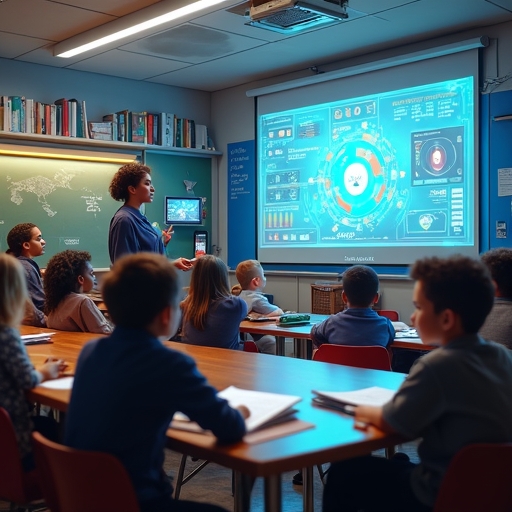
Embracing AI in Classrooms: How Sci-Fi Sparks Innovation
Embracing AI in Classrooms is transforming the educational landscape in ways that only a few decades ago belonged to the realms of science fiction. This transformation, inspired by the aspirational narratives of sci-fi literature and film, challenges teachers and students alike to imagine new possibilities beyond traditional pedagogical practices. AI in education is no longer confined to tech labs or futuristic boardrooms—it is here, integrated into the fabric of the classroom experience, and its effects are both profound and far-reaching.
The Sci-Fi Lens: Imagining New Educational Realities
Science fiction has always served as a visionary guide to potential futures. The stories of high-tech cities, intelligent machines, and virtual realities have not only captivated our imaginations but have also laid the groundwork for future technological innovations. Educators are increasingly drawing on Science Fiction Inspiration to cultivate a forward-thinking mindset among students. In this context, sci-fi serves as both a metaphor and a blueprint for integrating cutting-edge technology into everyday learning environments.
This imaginative tradition encourages teachers to view the classroom as a dynamic space where creativity and critical thinking merge with technical skills. When educators embrace the narrative of futuristic classrooms, they empower students to think outside the box and to approach problems with innovative perspectives. The classroom becomes a space where ideas from classic sci-fi narratives are reinterpreted and used to solve modern challenges, laying a foundation for experimental and engaging educational practices.
Synthesizing AI and Imagination: A New Pedagogical Model
At its core, AI in Education is about leveraging advanced algorithms to personalize learning and automate routine tasks, allowing educators more time to focus on engaging with students. The infusion of AI technologies—such as adaptive learning systems, virtual assistants, and smart content creation tools—provides educators with powerful new resources. When these technologies are brought into the classroom with an eye on the imaginative possibilities inspired by sci-fi, they transcend mere utility and become vehicles for transformative learning experiences.
This melding of technology and creativity has led to the development of innovative teaching practices that can be aligned with futuristic visions. By integrating Innovative Teaching Practices that pivot on AI-driven insights, teachers are crafting environments where students are encouraged to be curious and bold. These practices are not just about improving test scores; they are aimed at inspiring students to become pioneers of technology, problem solvers, and lifelong learners.
The Challenges and Opportunities of AI Integration
While the rapid adoption of AI in classrooms presents many exciting opportunities, it also brings significant challenges. One of the primary issues raised is the question of equity. Ensuring that every student benefits from AI-based learning requires careful planning and resource allocation. The gap between schools with ample funding and those with limited resources can widen if not addressed properly. Nevertheless, by adopting well-rounded strategies, educators can leverage AI to mitigate some of these disparities.
Another concern involves the ethical considerations of data privacy and algorithmic bias. Teachers and administrators must be as vigilant about the ethical deployment of AI as they are enthusiastic about its potential. A balanced approach requires a dialogue that includes educators, technologists, policymakers, and even students. This dialogue can help clarify the ethical boundaries and establish fair practices when implementing AI tools in educational settings.
However, with these challenges come significant opportunities. Central to many forward-thinking strategies is the idea of using AI in Education as a springboard for redefining success and engagement in learning. The rise of personalized learning platforms, data-driven classroom management systems, and interactive educational games exemplifies how technology can respond to individual student needs while mobilizing a collective enthusiasm for learning.
Implementing Innovative Teaching Practices with AI
Educators looking to incorporate AI into their curriculum find themselves at the intersection of educational theory and technological innovation. Adopting these new methods requires a commitment to continuous professional development and a willingness to experiment with novel classroom formats. One exemplary approach is to treat AI tools as co-educators rather than as replacements for the essential human element in learning. This perspective not only enhances traditional teaching methods but also provides a framework to introduce students to emerging technologies in a controlled and thoughtful manner.
For instance, a teacher might use adaptive learning software that tailors assignments to each student’s competency level. This method addresses individual challenges and supports a pace of learning that is respectful of personal differences. By aligning lessons with the envisioned futures depicted in many sci-fi narratives, instructors foster an atmosphere where curiosity is rewarded and every classroom session feels like an exciting exploration into uncharted territories.
Setting the Stage for a Personalized Learning Experience
The concept of personalized learning is central to the conversation on AI in classrooms. With advanced data analytics and predictive algorithms, educational software can assess a student’s strengths and areas in need of improvement. In this way, teachers stand as facilitators who can interpret insights provided by AI systems and seamlessly integrate them into lesson plans. With every interaction, the classroom becomes a well-oiled machine that keeps the psychological and academic rhythms of each learner in check.
Moreover, educators are now able to use these technologies to not only gauge academic performance but also monitor engagement, interest levels, and even social interactions among students. This comprehensive approach enables a much deeper understanding of the classroom ecosystem. As such, these innovative strategies can lead to teaching practices that incorporate continuous feedback and foster a more interactive and inclusive educational environment.
Leveraging Expert Insights and Specialized Guidance
Transitioning to an AI-enhanced classroom is not an overnight process. It demands meticulous planning, informed decision-making, and a nuanced understanding of both pedagogy and technology. Many educators are turning to experts who specialize in AI in Education to ensure that this transition is smooth and effective. For instance, tapping into expert guidance available via platforms like AI consulting can provide tailored insights that help educators overcome initial hurdles while building sustainable systems for technology integration.
This specialized support not only assists in choosing the right technological tools but also empowers schools to train their teachers effectively. In turn, a well-prepared teaching staff can significantly reduce the friction that might otherwise come with implementing AI-based systems. The result is an educational environment that is both progressive and responsive to the dynamic needs of its students.
Real-Life Experiences: Success Stories and Lessons Learned
Across various educational institutions, real-life examples of successfully integrating AI into the classroom have begun to emerge. Teachers who courageously step into the intersection of technology and imagination are reporting remarkable improvements in student engagement and personalized learning outcomes. In several pilot projects, students exposed to adaptive learning environments have demonstrated enhanced problem-solving skills and greater enthusiasm for subjects once considered challenging.
The implementation of AI-enabled tools has also allowed educators to gain valuable insights into student behavior and learning patterns. This data-driven decision-making underpins the adjustments teachers make on a daily basis—whether updating a lesson plan or adopting a more interactive teaching method based on immediate feedback. Such success stories underscore how investing time and energy into Innovative Teaching Practices can yield long-term benefits that go well beyond the classroom.
In environments where traditional education methods once dominated, the infusion of AI has brought a renewed sense of purpose and innovation. Educators now use AI not simply as a novelty or convenience, but as a pivotal element that reinvigorates their teaching methods and bridges theoretical knowledge with practical applications. As the community of educators grows more adept at navigating these technological shifts, the collective experience once mired in uncertainty is transforming into a narrative of opportunity and hope.
Redefining Classroom Dynamics for a Digital Era
As technology continues to permeate every facet of modern life, the expectations placed on educational institutions are evolving concurrently. The future calls for classrooms where technology is not an accessory but an essential aspect of daily instruction. In this redefined landscape, educators are expected to cultivate spaces where critical thinking, empathy, and analytical skills are nurtured alongside computational literacy.
Adapting to these expectations requires a shift in mindset—a willingness to let go of traditional silos of knowledge and embrace a modular approach to learning. When teachers integrate AI into their classrooms, they create an environment that fosters collaboration and digital fluency. Students are encouraged to use technology not simply to absorb information but to explore, create, and innovate. This change is paving the way for a generation of learners who are as comfortable coding as they are discussing ethical dilemmas, and who see technology as a powerful ally in solving real-world problems.
The dialogue between technology and pedagogy extends beyond mere classroom practices. Schools are now becoming incubators for interdisciplinary learning where subjects like ethics, sociology, and computer science intersect to produce holistic educational experiences. Such integrative practices are fueling an intellectual renaissance in classrooms, where technology is celebrated for its ability to enhance learning and make education more adaptive to the needs of each student.
Embracing Continuous Innovation
The journey to fully integrating artificial intelligence in education is ongoing and evolving. Educators must be willing to adapt as new AI technologies emerge and become part of the educational fabric. This long-term commitment to innovation is demanding, yet the rewards are immeasurable. By nurturing an environment that values creativity, collaboration, and critical analysis, teachers are laying the groundwork for educational systems that can withstand the rapid pace of technological change.
Furthermore, the iterative process of integrating AI encourages educators to remain engaged with both the technological advancements and the evolving needs of their students. Institutions that view this as a collaborative venture can harness a thriving culture of innovation that benefits everyone—from administrators to teachers, and most importantly, the students themselves. The future of education depends on these early adaptations and on teachers who are willing to explore new paths to learning.
Bringing Together Imagination and Technology for Tomorrow’s Leaders
The integration of AI into the classroom, spearheaded by the creative influences of science fiction, is more than a technological shift—it is a cultural transformation. As educators continue to explore the intersection of AI in Education and imaginative storytelling, they are crafting academic experiences that are as enriching as they are forward-thinking. This transformation is not merely about automating tasks or personalizing learning; it is about redefining what education can be in an increasingly digital age.
The synthesis of sci-fi-inspired narratives and AI-driven innovations has set the stage for a future where classrooms are vibrant, adaptive, and inclusive. Educators are now empowered to experiment and to inspire, using every piece of available technology as a tool for unlocking untapped potential. The emerging landscape is one where every student is given the opportunity to engage deeply with both technology and humanistic values—a balance that is critical for navigating future challenges.
As this transformation accelerates, it invites every teacher, administrator, and policymaker to take part in building a more dynamic future. The path forward is illuminated by creativity and harnessed through technology, inviting us all to contribute to an educational revolution that promises to be as exciting as it is transformative. By viewing each classroom as a microcosm of what the future can be, educators continue to affirm that the integration of AI is not just an upgrade to traditional teaching methods, but a reimagining of learning itself.
This ongoing evolution is a call to intrepid educators and learners alike: explore the boundaries of what is possible, challenge the status quo, and embrace the profound change that comes with Innovative Teaching Practices. Whether you are a seasoned educator or a student of life, now is the time to engage with these technologies constructively. Through continuous collaboration, support, and a shared vision for a more creative future, we can all help to shape an educational system that is truly ready for the digital era.
If you are passionate about the transformative potential of AI and eager to discover how these breakthroughs can be effectively integrated into everyday teaching, consider exploring additional insights and expert perspectives. Engage with the growing body of knowledge that links imagination, ethics, and technology, and let the journey of innovation continue.
